

Preschool
Academics
Elementary Philosophy
St. James’ keeps our students at the very center of learning and instruction. Paramount to our philosophy of teaching and learning is the belief that intelligence is not a fixed commodity. No matter what type of learner enters our doors, St. James’ students receive excellent academic instruction. We support your child’s individual advancement and achievement by finding appropriately challenging entry points and learning experiences. Our value of challenging academic work is balanced with the value of and opportunity for creativity, versatility, and the fostering of meaningful relationships. Through thoughtfully designed learning environments, students are encouraged to explore, investigate, and work collaboratively.
We believe that a St. James’ education should provide our students with the thinking strategies they will need to solve problems and resolve conflicts in a complex and ever-changing world. Above all, we pledge to develop in our students a commitment to ethical behavior and an appreciation for the beautiful differences that mark each human being as an individual of immeasurable worth and dignity.
Curriculum for Lower Grades: Kinder - 3rd Grade
Kinder - 3rd
Grade
Curriculum
Kindergarten through 3rd Grade are the foundational elementary years where students are learning to read in Kindergarten and transitioning to reading to learn in 3rd grade. Plenty of time is built into the daily schedule allowing teachers to create an engaging, robust, nuanced curriculum that meets each individual student where they are. There is an hour each school day devoted to math, writing, social studies, and over 90 minutes to language arts. Kindergarten and 1st Grade receive 60 minutes of science instruction each week, and our 2nd and 3rd Grade classes receive over 90 minutes of science each week. This time is used for whole group instruction, small group learning center and individual teaching or conferencing. This model allows for students to express themselves while developing critical thinking skills and social relationships with their peers and teachers.
Language Arts
The Language Arts block in Kindergarten consists of the Express Readers Program (Phonics and Reading) and the Writers’ Workshop Program. The best strategies from both programs are combined to truly support our kindergarteners’ reading, phonics, and writing skills.
- Students explore beginning reading concepts through read alouds, small group work and decodable readers.
- Phonics incorporates consonants with a focus on the lowercase letters, beginning and ending sounds, short vowels, digraphs, blends, and much more.
- Writers Workshop encourages students to get their ideas on paper through the student’s choice of topic, inventive spelling and individual conferencing with teachers.
Math
In Kindergarten math, we provide students with learning activities that truly foster a strong foundation for mathematical skills. We emphasize hands-on learning opportunities, visualization, and real world applications.
- A concrete-pictorial-abstract approach is used when introducing new concepts.
- Students look at math in the world around them and create number stories, the beginning of their work with word problems.
- Students learn skills that are needed to transition into the upper grades such as explaining their thinking using a model, in words, and with an algorithm including demonstrating different strategies for solving a problem.
Social Studies
In Kindergarten social studies, students learn about skills that will be used in the classroom and beyond.
- Social skills (e.g. awareness, responsibilities, solving problems, etc.), care for the environment, respect for all, an understanding of the past, present, and future are all explored.
- Students explore their identity through All About Me projects and learn about world traditions throughout the year.
- Community (class, school, neighborhood, city, state, etc) are discussed and studied.
Click here to learn more about our 9 co-curricular classes which include Spanish, Performing Arts, Physical Education, Music, Art, Design & Technology, Social-Emotional Learning, Religion, and Library.
Language Arts
First Grade literacy blocks are designed to ensure that each child engages in small group learning and one-on-one conferencing with the teachers to monitor individual progress.
- Reading elements/skills that are woven into our program throughout the year include: comprehension, summarizing, main idea, setting, sequencing, using context clues, problem and solution, and identifying characters.
- Narrative, Persuasive, Informational writing are introduced and explored through “individual choice” of topic stories.
- In the Express Readers Phonics program, students study long vowel sounds, consonant digraphs, vowel teams, sneaky “e” and multisyllabic words.
Math
In First Grade math, we provide students with learning activities that truly foster a strong foundation for mathematical skills. We emphasize hands-on learning opportunities, visualization, and real world applications.
- Students work on addition and subtraction fluency to 20 but they also work up to the number 120 and beyond.
- Students start recognizing the potential for mathematical problem solving in their everyday environments.
- Math concepts include money, time, shapes, graphs, charts, measurement add place value.
Social Studies
Social studies in First Grade focuses on helping students embrace their unique selves, celebrating the diversity in the world around them, recognizing their role as part of a larger community/communities, and advocating for kindness and empathy.
- Students demonstrate their learning through drawings, written work, class discussions, and hands-on projects.
- Projects include exploring one’s identity, community, and cultures and traditions around the world.
- Students learn basic US history. For example: how laws are made, the role of the President, Governor and Mayor and historic landmarks and essential documents.
Click here to learn more about our 9 co-curricular classes which include Spanish, Performing Arts, Physical Education, Music, Art, Design & Technology, Social-Emotional Learning, Religion, and Library.
Language Arts
Second Grade students continue to expand on the foundational skills learned in first grade. The curriculum of Express Readers and Writer’s Workshop are still used.
- Language Comprehension mixed with word recognition creating skilled readers.
- Chapter books are introduced as class texts in addition to decodable books to support students on their individual journey to fluent reading.
- Writer’s Workshop topics include Small Moments – Personal Narrative, Nonfiction – Research Passion Project, Persuasive Writing and Poetry.
Math
In Second Grade, the hands on approach along with the use of the concrete, pictorial and abstract process to math supports students as they engage with larger numbers and more advanced concepts while supporting basic fluency of operations.
- Math journals along with the textbook allow students to show what they know in multiple forms using both numbers and written language.
- Students practice solving multi-digit addition and subtraction word problems that involve real life scenarios, money, measurement and mass by using various methods including using bar models.
- Math curriculum includes, 2 and 3 dimensional shapes, fractions, measurement and the introduction to multiplication and division.
Social Studies
Second Grade social studies continues the exploration of personal identity, community, and the world in which we live.
- Projects include exploring the lives of those who have impacted history and recognize the importance and contribution of diversity in the origin and growth of America.
- Exploration of individual history through family mementos, cultural food, photographs, etc.
- Learning about different communities and the construction of simple maps using keys, legends, and the compass rose.
Science
Students in grades 2 through 6 explore three core areas of science: Earth Science, Life Science, and Physical Science. Our curriculum is hands-on and inquiry-based, encouraging students to ask questions, investigate, and discover. Lessons are aligned with the Next Generation Science Standards (NGSS), integrating:
- Disciplinary Core Ideas
- Science and Engineering Practices
- Crosscutting Concepts
This integrated approach helps students build a deep, well-rounded understanding of scientific principles while developing critical thinking and problem-solving skills.
- Earth Science
Students learn about landforms and how erosion and weathering shape the Earth’s surface, using clay models and experiments to bring these concepts to life. - Physical Science
This unit focuses on the properties of matter—solids, liquids, and gases—through hands-on activities. Students explore how materials change with heat and create their own hats using various materials. - Life Science
Students observe plants and animals, studying seeds, plant life cycles, and various habitats. They learn about local birds and design prototypes of bird feeders to meet different bird needs.
Click here to learn more about our 9 co-curricular classes which include Spanish, Performing Arts, Physical Education, Music, Art, Design & Technology, Social-Emotional Learning, Religion, and Library.
Language Arts
Third grade students continue their development of reading and writing through novel studies and direct grammar lessons.
- Daily journal writing which allows for student expression and reflection.
- Hands on activities support various learning modalities before applying the skills to writing assignments.
- Practice with the writing process (prewrite, draft, revise, edit, final publishing) with descriptive, persuasive, and informational writing.
Math
The goal is to empower students to develop the critical-thinking skills, positive attitudes, and confidence needed to set the stage for achievement in math.
- Students create a stronger foundation in math by showing their thinking through multiple modalities: Making Models, Using Algorithms and Explaining in words.
- Concrete-pictorial-abstract development, and use of model drawings to connect visual representation to problem solving.
- Use of the four operations to solve multi-step word problems, fractions, decimals, 2 and 3 D shapes, and adding and subtracting within 1000.
Social Studies
Third grade students dive deep into the study of our great state of California in Social Studies.
- Students continue to develop the skills of being active and responsible community members.
- Exploration of early Native American tribes and Indigenous communities.
- Curriculum includes the understanding that words and connections matter, how to see, understand and honor multiple viewpoints of history, and the continued embracing of a Culture of Inclusion.
Science
Students in grades 2 through 6 explore three core areas of science: Earth Science, Life Science, and Physical Science. Our curriculum is hands-on and inquiry-based, encouraging students to ask questions, investigate, and discover. Lessons are aligned with the Next Generation Science Standards (NGSS), integrating:
- Disciplinary Core Ideas
- Science and Engineering Practices
- Crosscutting Concepts
This integrated approach helps students build a deep, well-rounded understanding of scientific principles while developing critical thinking and problem-solving skills.
- Earth Science
Students investigate weather patterns, cloud types, and local climate. They also explore natural hazards and their impact on people and the environment. - Physical Science
This unit introduces force and motion, with hands-on activities exploring how objects move and interact. Students also study magnetism and test how magnetic forces affect different materials. - Life Science
Students explore habitats, fossils, and environmental change over time. Activities include a fossil dig, creating fossil models, and studying pollination, animal behaviors, and traits that support survival in ecosystems.
Click here to learn more about our 9 co-curricular classes which include Spanish, Performing Arts, Physical Education, Music, Art, Design & Technology, Social-Emotional Learning, Religion, and Library.
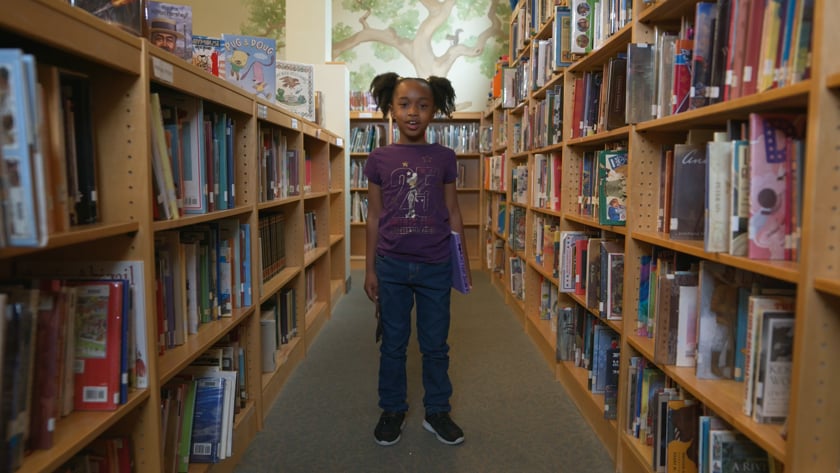
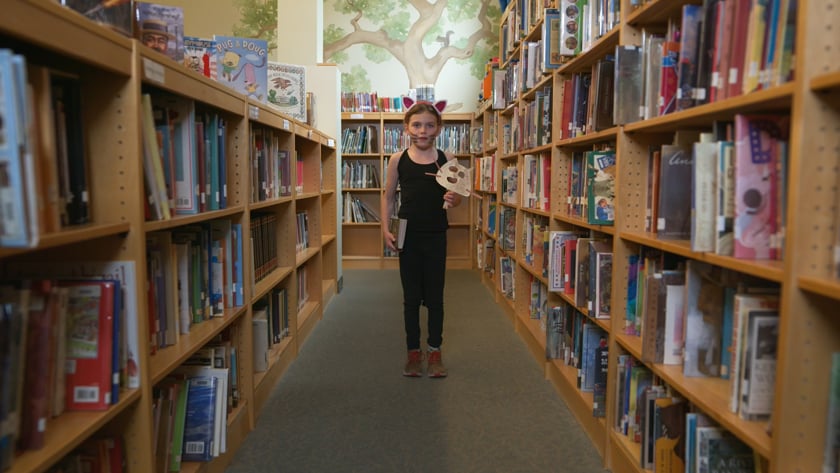
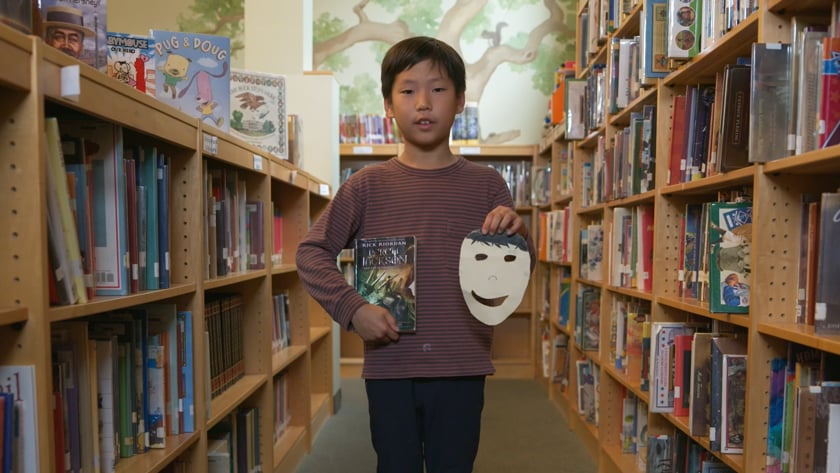
Highlights from our 2nd Grade Curriculum
Second Grade Character Study Presentations:
Curriculum for Upper Grades: 4th - 6th Grade
4th - 6th
Grade
Curriculum
The upper grade years – 4th through 6th – are a crucial period in students’ learning, as children become more independent. Upper grade students are encouraged to work collaboratively with their peers, begin to understand themselves more as learners, and self-advocate when necessary. As they progress through the program, students encounter a rigorous curriculum and develop the analytical, problem solving and writing skills they’ll need to succeed as they enter middle school. Teachers at St. James’ understand the tween years and know how to create an environment where children will flourish and develop self-confidence. The upper grade experience is all about tackling new academic challenges and navigating through transitions.
Language Arts
Fourth graders receive daily instruction in language arts that supports reading and writing across the curriculum and word study.
- Students study a variety of literary genres and practice comprehension and analysis strategies including summarizing, inferring, and synthesizing information.
- Various forms of writing are studied including narratives, essays, reports, and letter writing.
- The writing program emphasizes conventions and implementation of grammar, punctuation, and capitalization.
- Students review rules for spelling multisyllabic words and deepen their knowledge of word origins and derivations
Math
Fourth grade mathematicians apply all that they know about the four operations (addition, subtraction, multiplication and division) with large multi-digit numbers.
- The program emphasizes the use of problem solving and an ability to demonstrate mathematical thinking in a variety of contexts.
- Students identify, simplify, compare, and convert fractions, mixed numbers, and decimals and use them to solve problems.
- Concepts of geometry and measurement are studied along with the interpretation of data and graphs.
- Students are introduced to the order or operations and simple variables to solve for algebraic expressions.
Social Studies
The fourth grade social studies curriculum dives into the story of California.
- Alongside an investigation into types of maps, students explore California’s four natural regions, physical features, and resources, and the history and value of California’s Indigenous Peoples.
- Students understand how the mission period, rancho period, the Gold Rush, and the construction of the transcontinental railroad impacted the state’s history, economy, environment, and native and immigrant communities.
- The course continues to the origins of California statehood and the structure of state government.
- Students gain an understanding of how important events in the 20th century and the civil rights movement affected the people of California.
Science
Students in grades 2 through 6 explore three core areas of science: Earth Science, Life Science, and Physical Science. Our curriculum is hands-on and inquiry-based, encouraging students to ask questions, investigate, and discover. Lessons are aligned with the Next Generation Science Standards (NGSS), integrating:
- Disciplinary Core Ideas
- Science and Engineering Practices
- Crosscutting Concepts
This integrated approach helps students build a deep, well-rounded understanding of scientific principles while developing critical thinking and problem-solving skills.
- Earth Science
Students explore Earth’s dynamic processes, including plate tectonics, volcanoes, and earthquakes. They investigate weathering and erosion, develop map skills, and create a 3D topographic model of Mt. Shasta. - Physical Science
This unit focuses on waves, energy, and information transfer. Students investigate how sound travels, send messages using circuits, explore renewable energy, and apply engineering skills to build and test model roller coasters. - Life Science
Students study plant structure, animal adaptations, and how living organisms process information. The unit includes a focus on the brain, nerves, and senses—culminating in a sheep eye dissection.
Click here to learn more about our 9 co-curricular classes which include Spanish, Performing Arts, Physical Education, Music, Art, Design & Technology, Social-Emotional Learning, Religion, and Library.
Language Arts
In language arts, fifth graders cultivate strong inferential and comprehension skills.
- English instruction includes vocabulary development and frequent writing about literature.
- Students read extensively and engage in discussion of literary elements and critical analysis of fiction.
- The writing curriculum focuses on expository and formal essay composition, poetry, personal narratives and creative pieces.
Math
In 5th grade, students continue to develop number sense and foundational concepts that move them toward algebraic reasoning.
- Students apply the order of operations to solving equations and word problems.
- Multiplication and division are used to work with fractions and mixed numbers, decimals, and powers of ten.
- Students develop greater fluency in calculating the area, perimeter, and volume of two and three-dimensional shapes.
- The graphing, plotting, and interpretation of data points is embedded in instruction.
Social Studies
Our fifth graders understand that early American history is a series of cause and effect events.
- Their course begins with the study of Indigenous Peoples and, eventually, the impact of colonial settlements.
- Students learn about the aims, obstacles, and impact of key European expeditions and colonization.
- Fifth graders develop research and note-taking skills and consider contradictions and compromises in the early development of America.
- Using primary and secondary sources, students learn about the fight for independence and the establishment of the American government.
Science
Students in grades 2 through 6 explore three core areas of science: Earth Science, Life Science, and Physical Science. Our curriculum is hands-on and inquiry-based, encouraging students to ask questions, investigate, and discover. Lessons are aligned with the Next Generation Science Standards (NGSS), integrating:
- Disciplinary Core Ideas
- Science and Engineering Practices
- Crosscutting Concepts
This integrated approach helps students build a deep, well-rounded understanding of scientific principles while developing critical thinking and problem-solving skills.
- Interactive Science Notebooks
Students in 5th and 6th grade use interactive science notebooks to organize their learning. These notebooks serve as a place to record labs, notes, reflections, questions, and activities. - Science Fair
Each year, 5th and 6th grade students take part in the annual science fair. They select a topic of interest, apply the scientific process, and conduct experiments over several months. The fair culminates with students presenting their findings to peers, teachers, and families. - Earth Science
Students study the water cycle, natural disasters, and explore patterns of the Earth, Sun, Moon, and stars. The unit wraps up with a student-designed rocket launch engineering challenge! - Physical Science
This unit focuses on the properties of matter and chemical reactions. Students model and investigate how matter changes while conserving mass. Students are introduced to the periodic table of elements and create model atoms. - Life Science
Students explore energy flow in ecosystems through food chains, food webs, and the roles of producers, consumers, and decomposers. Students learn to compost in the classroom and have the option to participate in an earthworm dissection as part of their learning about decomposers. Photosynthesis is introduced as a key energy source in the food chain.
Click here to learn more about our 9 co-curricular classes which include Spanish, Performing Arts, Physical Education, Music, Art, Design & Technology, Social-Emotional Learning, Religion, and Library.
English
The sixth grade English classroom encourages students to consider multiple perspectives, gain empathy, and to think critically about the world around them.
- Sixth-graders have multiple opportunities for public speaking, including delivering speeches and presentations.
- Students hone comprehension and analysis strategies by interpreting literary elements and various literary genres.
- With support from our Writing Specialist, students develop their own voices and an ability to communicate in their own style.
- Using the Six Traits of Writing, students write across genres, generating compositions of at least 500 to 700 words.
Math
Sixth grade mathematicians apply all that they know about the four operations with large multi-digit numbers.
- Students are fluent using the four operations to solve problems involving fractions, mixed numbers, and decimals.
- Sixth graders are able to identify prime and composite numbers and use them to identify common factors and multiples.
- The course emphasizes an understanding of percentages and rates.
- Algebraic concepts are taught and students evaluate and simplify algebraic expressions.
Social Studies
Sixth graders engage in a study of early humans and the ancient civilizations.
- The course explores the similarities and differences of ancient societies including Egypt, India, China, Greece, and Rome.
- Students investigate geography, political systems, culture and religion, economics and technology.
- Sixth graders develop note-taking, research, and mapping skills.
- The curriculum examines Western and non-Western progress in ancient times and the transformation of societies into civilizations.
Science
Students in grades 2 through 6 explore three core areas of science: Earth Science, Life Science, and Physical Science. Our curriculum is hands-on and inquiry-based, encouraging students to ask questions, investigate, and discover. Lessons are aligned with the Next Generation Science Standards (NGSS), integrating:
- Disciplinary Core Ideas
- Science and Engineering Practices
- Crosscutting Concepts
This integrated approach helps students build a deep, well-rounded understanding of scientific principles while developing critical thinking and problem-solving skills.
- Interactive Science Notebooks
Students in 5th and 6th grade use interactive science notebooks to organize their learning. These notebooks serve as a place to record labs, notes, reflections, questions, and activities. - Science Fair
Each year, 5th and 6th grade students take part in the annual science fair. They select a topic of interest, apply the scientific process, and conduct experiments over several months. The fair culminates with students presenting their findings to peers, teachers, and families. - Earth Science
Students explore Earth’s four spheres—hydrosphere, atmosphere, geosphere, and biosphere—and how they interact. They study weather, climate, and ocean currents, and are introduced to climate change and human impact. - Physical Science
This unit focuses on energy and energy transfer, including thermal and kinetic energy. Students investigate light, refraction, reflection, and absorption through interactive labs. - Life Science
Students examine cells, unicellular organisms, multicellular organisms and animal classification. They are introduced to how body systems work together. The unit concludes with a frog dissection to apply their learning in a real-world context.
Click here to learn more about our 9 co-curricular classes which include Spanish, Performing Arts, Physical Education, Music, Art, Design & Technology, Social-Emotional Learning, Religion, and Library.
Collaborative Teaching & Learning Model


We can't wait to meet you!
Academics


